
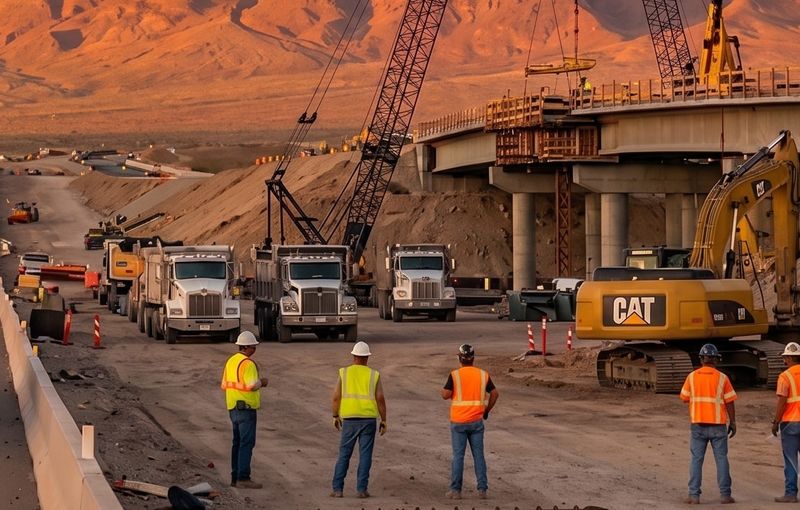
Washington sand & gravel
Six inches of freeboard or a tarp. UTC permit for paid in-state hauls.
Dump Truck Insurance for Washington Sand and Gravel Haulers
Washington’s rule for dirt, sand and gravel fits on one line: cover the load, or keep six inches of freeboard in the bed. If you haul around Seattle, Tacoma, Kent, Bellevue, Spokane or Vancouver, here’s what else the state asks of a dump truck operation. Byrd Insurance, in North Las Vegas, quotes Washington-based haulers.
- Independent agencyMultiple carriers and wholesale markets
- Office in North Las Vegas, NVMonday–Friday, 8 am–5 pm
- 9 western states servedNV · AZ · CA · CO · NM · OR · TX · UT · WA
What’s different in Washington
Cover it, or keep six inches of freeboard
Under RCW 46.61.655, a vehicle on a paved public highway “with a load of dirt, sand, or gravel” must have the load covered to prevent spillage. Covering isn’t required “if six inches of freeboard is maintained within the bed.”
Clean the truck, too
Vehicles carrying mud, rocks or other debris have to be cleaned before they operate on a paved public highway.
Penalties
Failing to comply is an infraction. Criminal negligence that causes substantial bodily harm is a gross misdemeanor, and under the general load rules, causing property damage is a misdemeanor.
The statute has the current text.
Coverage to ask us about for Washington dump trucks
Auto liability
The coverage your UTC filing or federal filing rests on. Tell us if a contract sets a limit above the UTC minimum.
Physical damage
For each truck, pup, transfer and dump body you list, with a value and deductible for each.
Cargo
If a customer, contract or state filing calls for cargo coverage, tell us when you request a quote.
General liability
For claims that come from your work at a site rather than from driving.
Umbrella
Can add liability limits above policies such as your auto liability, for contracts that ask for more. Which policies it sits over depends on its terms.
Payment under any policy turns on its terms, limits and exclusions.
Hauling for pay: the UTC permit
Under the Utilities and Transportation Commission’s rules, a common carrier is anyone transporting property for the public for compensation. The carve-outs are household goods carriers, solid waste collection companies and exempt carriers. The statutory exemptions in RCW 81.80.040 include vehicles hauling “exclusively water in connection with construction projects only,” but none for sand, gravel, rock, construction materials or dump trucks.
So for-hire dump truck work inside Washington needs the UTC common carrier permit, and the insurance that comes with it. Under WAC 480-14-250, as of November 2026:
- Minimum. $750,000 for nonhazardous property in vehicles rated 10,000 lbs GVWR or more.
- Form E per vehicle. Evidence of liability and property damage insurance is filed for each motor vehicle used under the permit.
- Binder window. A binder is valid for up to 60 days, and the Form E has to be filed within that time.
- Renewals and cancellations. Proof of continued coverage is due at least 10 days before current coverage ends, and a Form K cancellation needs at least 30 days.
Check the rule for current figures. Washington also requires a USDOT number for intrastate operations, at 16,001 lbs GVWR or more for carriers not otherwise covered.
Interstate loads, hours and the pit
- Interstate without crossing. A haul that never leaves Washington can still be interstate commerce under federal safety rules, if the load’s movement starts or ends in another state. Separately, for-hire interstate hauling of nonhazardous freight in trucks of 10,001 lbs or more carries a $750,000 federal liability floor as of November 2026, and the insurer files proof with FMCSA. Byrd places the coverage.
- Short-haul drivers. If you’re under the federal hours-of-service rules, a driver who stays within 150 air miles of the normal reporting location and is released within 14 consecutive hours, with 10 hours off between shifts, is exempt from the federal logbook and ELD record rules.
- Pit training. At sand and gravel pits, federal MSHA rules have the mine operator give site-specific hazard awareness training to commercial truck drivers before they’re exposed to mine hazards, unless an experienced miner accompanies them.
Where the work is
Washington ranked 7th nationally for construction sand and gravel output in 2025, according to USGS. By Census estimates for July 1, 2025, Seattle is the largest city, followed by Spokane, Tacoma, Vancouver, Bellevue and Kent.
Your home office and where you run
For trucking, your home office has to be in one of the 9 states we serve: Arizona, California, Colorado, Nevada, New Mexico, Oregon, Texas, Utah and Washington. If your trucking business is based in one of these 9 states, your trucks can run in all 50 states and Canada, subject to underwriting approval and policy terms.
What we need from you to quote
- Your USDOT number and UTC common carrier permit status
- Each unit’s year, make, GVWR, axle count and body type (end dump, transfer, truck-and-pup, belly dump)
- Whether your hauling is for pay, for your own jobs, or both
- The pits and job sites you serve, and whether you run into Oregon or Idaho
- Your drivers and how long each has run a dump truck
- Dec page and loss runs, if a policy is in force
You don’t need all of this to start. The form asks for the basics, and we’ll ask for the rest after we talk. Please don’t put driver’s license numbers, dates of birth or Social Security numbers in the form.
How it works
- Send the trucking quote form or call our North Las Vegas office, with your UTC permit status if you haul for pay inside Washington.
- We look at your trucks, weights and drivers and take them to multiple carriers and wholesale markets.
- We go over the options with you before anything is bound.
Ready for a quote?
We shop multiple carriers and wholesale markets from our North Las Vegas office.
Get a trucking quoteOr call (702) 944-5218Office hours: Monday–Friday, 8 am–5 pm
Frequently asked questions
Don’t see your question? Call our North Las Vegas office and ask.
Call (702) 944-5218Do I have to tarp sand and gravel in Washington?
RCW 46.61.655 requires a load of dirt, sand or gravel on a paved public highway to be covered to prevent spillage, unless you keep six inches of freeboard within the bed. Mud and rocks also have to be cleaned off the truck before it goes onto pavement. See the statute for its current wording.
Is there a UTC exemption for dump trucks or aggregate?
Washington’s statutory exemptions don’t include sand, gravel, rock, construction materials or dump trucks; the construction-related one covers vehicles hauling only water for construction projects. Hauling property for pay inside Washington needs a UTC common carrier permit unless an exemption applies, so ask the UTC about your setup.
What liability does the UTC require for a dump truck?
As of November 2026, WAC 480-14-250 sets $750,000 for nonhazardous property in vehicles of 10,000 lbs GVWR or more, with a Form E on file for each vehicle. A binder is good for up to 60 days while the Form E is filed. Check the rule for current figures.
Does a Washington-only dump truck need a USDOT number?
Washington law requires a USDOT number for intrastate operations, and carriers not otherwise covered need one at 16,001 lbs GVWR or more. If you already hold a current USDOT number, you don’t need a separate Washington number. Check RCW 46.32.080 for the details.
Let’s quote your dump trucks
Tell us about your trucks, your drivers and the pits and jobs you haul for. We’ll shop multiple carriers and wholesale markets and walk you through the options.
Sand and gravel trucking in our other states
- Nevada sand and gravel truck insurance
- Arizona sand and gravel truck insurance
- California sand and gravel truck insurance
- Colorado sand and gravel truck insurance
- New Mexico sand and gravel truck insurance
- Oregon sand and gravel truck insurance
- Texas sand and gravel truck insurance
- Utah sand and gravel truck insurance
Related pages
Washington trucking insurance
Washington trucking insurance: the UTC common carrier permit, Form E limits under WAC 480-14-250, and state USDOT rules.
Cargo and physical damage insurance for trucks
Motor truck cargo and physical damage insurance from North Las Vegas: common exclusions, reefer breakdown, truck values, trailer interchange.
MCS-90 and FMCSA insurance filings
The MCS-90 endorsement, BMC-91X and BMC-34 explained: who files, federal minimums and cancellations. From our North Las Vegas office.
Trucking insurance for Western carriers
Trucking insurance for carriers based in 9 Western states: liability, cargo and physical damage, and how FMCSA filings work.