
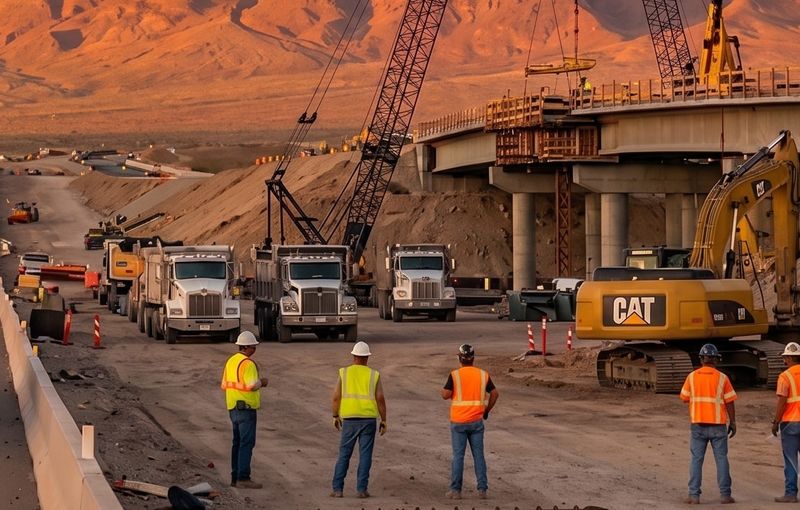
Oregon sand & gravel
Flat fee or weight-mile tax? In Oregon, qualifying dump trucks choose.
Dump Truck Insurance for Oregon Sand and Gravel Haulers
In Oregon, a dump truck hauling sand and gravel from a pit to a construction job can choose how it pays road tax: weight-mile, or a flat monthly fee. That choice, and the rate change coming in 2027, lead this page for haulers in Portland, Salem, Eugene, Gresham, Hillsboro and Bend. Our office is in North Las Vegas, and Oregon is one of our 9 states.
- Independent agencyMultiple carriers and wholesale markets
- Office in North Las Vegas, NVMonday–Friday, 8 am–5 pm
- 9 western states servedNV · AZ · CA · CO · NM · OR · TX · UT · WA
What’s different in Oregon
The flat fee option for dump trucks
Instead of weight-mile tax, Oregon lets carriers elect an annual flat fee, paid monthly, for qualified commodities. ODOT’s list includes vehicles with dump bodies hauling sand, gravel, rock, dirt, debris, cinders, asphaltic concrete mix, metallic ores and concentrates, or raw non-metallic products from mines, pits or quarries, when the hauling is tied to a highway or other construction project.
Per truck, per month
The fee is due for each vehicle that hauled an elected flat-fee commodity in the reporting month.
Pick and stick
Once you elect a method, you can’t switch within the calendar year.
A higher rate in 2027
ODOT says the flat fee rate for sand and gravel dump commodities goes up on July 1, 2027, under House Bill 3991. It encourages sand and gravel haulers to compare weight-mile filing with flat fees.
We don’t print the rate here. Check ODOT’s weight-mile tax page for the rate in effect when you file.
Coverage to ask us about for Oregon dump trucks
Auto liability
The coverage behind your Form E with CCD, or your federal filing. Tell us the limits your contracts set.
Physical damage
For trucks, pups, transfers and dump bodies. Give us a value for each one.
Cargo
If a customer, contract or state filing calls for cargo coverage, tell us when you request a quote.
General liability
For claims from your work at a project site, not from the drive.
Workers’ comp
Have employees? Ask whether we can quote comp for your Oregon business.
Umbrella
Can add liability limits above policies such as your auto liability, for contracts that ask for more. Which policies it sits over depends on its terms.
The terms, limits and exclusions of each policy decide what it pays.
Weights and older diesels
- Weight tables. ODOT’s Table 1 (no permit) sets 80,000 lbs gross. Table 2 (extended weight, permit required) goes up to 105,500 lbs but lists truck-tractor and semitrailer, doubles, log truck and pole trailer, and triples; truck and trailer combinations appear only under Table 1. Ask CCD before you assume a truck-and-pup can run heavier.
- Portland-area diesels. Diesel retrofit rules apply to certain 1996-or-older diesels in Clackamas, Multnomah and Washington counties.
The load law
Under ORS 818.300, it’s a Class B traffic violation to drive, or as owner to allow, a vehicle “so constructed or loaded so as to allow its contents to drop, sift, leak or otherwise escape.” Violations also carry civil liability under ORS 818.410. Oregon’s statute sets no aggregate tarp or freeboard rule, but rock that leaves your bed is still a violation.
Hauling for pay inside Oregon
- Permit. Intrastate for-hire carriers apply for a Class 1A permit (Form 9745) along with an Oregon motor carrier account.
- Proof of insurance. Liability proof has to be on file with CCD within 60 days after your vehicles are registered and enrolled in weight-mile tax. You can’t operate on Oregon highways until the filing is received. A federal filing with FMCSA for interstate authority satisfies the intrastate filing.
- Minimums. As of November 2026, CCD lists a $750,000 combined single limit for auto liability, and cargo of $10,000 may be required. See CCD’s insurance requirements for current figures.
For-hire interstate hauling of nonhazardous freight also carries a federal minimum, $750,000 as of November 2026, with the insurance company filing proof at FMCSA.
Hours for construction hauls
If you’re under the federal hours-of-service rules, drivers used mainly to haul construction materials to active sites within 75 air miles of where they report can restart their 7- or 8-day clock with 24 hours off instead of 34.
Where the work is
Census estimates for July 1, 2025 list Portland, Salem, Eugene, Gresham, Hillsboro and Bend as Oregon’s largest cities.
Your home office and where you run
For trucking, your home office has to be in one of the 9 states we serve: Arizona, California, Colorado, Nevada, New Mexico, Oregon, Texas, Utah and Washington. If your trucking business is based in one of these 9 states, your trucks can run in all 50 states and Canada, subject to underwriting approval and policy terms.
What we need from you to quote
- Your USDOT number and Oregon motor carrier account number
- Whether you pay weight-mile tax or the flat fee, and your Class 1A permit status if you haul for pay in Oregon
- Each truck and pup: year, make, declared weight and body type
- The pits, quarries and projects you haul between
- Drivers (count yourself) and their years of dump truck experience
- Your loss history (loss runs) and current dec page, if you have them
You don’t need all of this to start. The form asks for the basics, and we’ll ask for the rest after we talk. Please don’t put driver’s license numbers, dates of birth or Social Security numbers in the form.
How it works
- Send us the trucking quote form or call our North Las Vegas office, and mention whether you’re on weight-mile tax or the flat fee.
- We take your trucks, pups and drivers to multiple carriers and wholesale markets.
- We review each option with you, with CCD’s minimum and your contracts in mind.
Ready for a quote?
We shop multiple carriers and wholesale markets from our North Las Vegas office.
Get a trucking quoteOr call (702) 944-5218Office hours: Monday–Friday, 8 am–5 pm
Frequently asked questions
Don’t see your question? Call our North Las Vegas office and ask.
Call (702) 944-5218Can Oregon dump trucks pay a flat fee instead of weight-mile tax?
ODOT lets carriers elect annual flat fees, paid monthly, for vehicles with dump bodies hauling sand, gravel, rock, dirt and similar materials from mines, pits or quarries for highway or other construction projects. The fee is due for each vehicle that hauled an elected commodity that month. Check ODOT’s Commerce and Compliance Division for current rates.
Is Oregon’s flat fee for sand and gravel changing?
ODOT says the flat fee rate for sand and gravel dump commodities goes up on July 1, 2027, under House Bill 3991, and it encourages haulers to compare flat fees with weight-mile filing. Check ODOT’s Commerce and Compliance Division for the rate in effect when you file.
What insurance does Oregon require for intrastate for-hire hauling?
As of November 2026, ODOT’s Commerce and Compliance Division lists a $750,000 combined single limit, and cargo coverage of $10,000 may be required. Proof has to be on file within 60 days after your trucks are registered and enrolled in weight-mile tax. Check CCD’s insurance requirements page for current figures.
Can a truck-and-pup run 105,500 lbs in Oregon?
Don’t assume it. ODOT’s weight tables list truck-and-trailer combinations only under Table 1, the no-permit table with an 80,000-lb gross limit; the extended-weight table up to 105,500 lbs lists other configurations. Ask CCD about your combination.
Let’s quote your dump trucks
Tell us about your trucks, your drivers and the pits and jobs you haul for. We’ll shop multiple carriers and wholesale markets and walk you through the options.
Sand and gravel trucking in our other states
- Nevada sand and gravel truck insurance
- Arizona sand and gravel truck insurance
- California sand and gravel truck insurance
- Colorado sand and gravel truck insurance
- New Mexico sand and gravel truck insurance
- Texas sand and gravel truck insurance
- Utah sand and gravel truck insurance
- Washington sand and gravel truck insurance
Related pages
Oregon trucking insurance
Oregon trucking insurance: the weight-mile tax and its 2027 and 2029 changes, CCD Form E and Form H filings, and Oregon permits.
Cargo and physical damage insurance for trucks
Motor truck cargo and physical damage insurance from North Las Vegas: common exclusions, reefer breakdown, truck values, trailer interchange.
Trucking insurance for Western carriers
Trucking insurance for carriers based in 9 Western states: liability, cargo and physical damage, and how FMCSA filings work.